
The Passion Translation
A Bible for the NAR

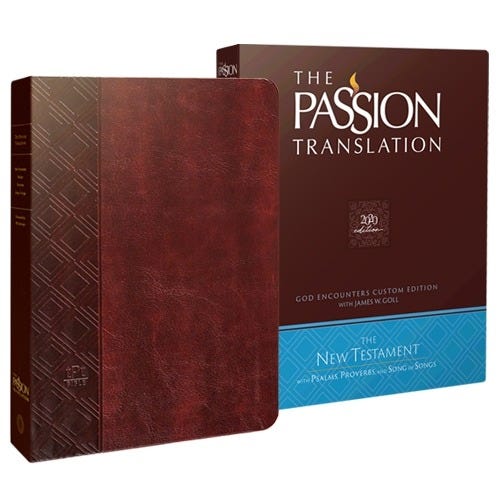
For centuries, believers have wrestled with how best to translate the Scriptures into different languages. Before the coming of Christ, portions of the Hebrew Scriptures were translated into Aramaic and Greek, making them accessible to people who did not know Hebrew.
Christians, charged to bring the Gospel to every nation, were quick to make translations. Even before St. Jerome produced his Latin version of the Bible, many partial Latin translations were produced in different lands. Parts of the Bible were also translated into Syriac (a dialect of Aramaic) before the year 500.
English translations of biblical books go back to the tenth century, and the first English version of the entire Bible came out in the fourteenth century. Today, people looking for an English-language Bible can choose from a very large number of translations — so large as to be bewildering.
Within the New Apostolic Reformation, one recent English version of the Bible is widely promoted: The Passion Translation (TPT). It has been endorsed by many NAR leaders, including Bill Johnson.
Johnson is joined in his endorsement by Ché Ahn of Wanger University, Heidi Baker, Bobbie Houston of Hillsong, Chuck Pierce, James Goll, and Lou Engle, among others.
Where Did The Passion Translation Come From?
TPT began as the work of one man, Brian Simmons. According to the publisher of TPT,
Brian is a linguist, minister, Bible teacher, and former missionary. As a missionary, he and his wife, Candice, pioneered church plants in Central America. As a linguist, Brian assisted in the Paya-Kuna New Testament translation project for the Paya-Kuna people of Panama. He and his wife have birthed numerous ministries, including a dynamic church in Connecticut. He is also a gifted teacher of the Bible who has authored several books and serves churches worldwide through his teaching ministry.
Apart from the time he spent with the Paya-Kuna translation project, Simmons has no formal academic training in Biblical languages. In 20023 he enrolled in a “Doctor of Practical Ministry” program at Wagner Leadership Institute (now called Wagner Leadership Global), founded by C. Peter Wagner. That program does not include training in Biblical languages. WLI’s description shows it to be a typical “school of supernatural ministry.”
Founded in 1998 by C. Peter Wagner, WLI reflects a new paradigm for unique training in practical ministry. Students learn in a creative, revelatory atmosphere of teaching, impartation and activation with opportunity for hands-on practical application and ministry. WLI provides the highest level of training and spiritual impartation through a successful faculty of internationally known leaders who walk and minister powerfully out of the five-fold ascension gifts. Students obtain a living, functioning impartation and activation from the Holy Spirit to walk in their divine destiny.
Simmons first produced an English version of the Song of Songs. Versions of the Psalms and all the books of the New Testament followed. A version of the entire Bible is projected to be completed in 2029. According to Simmons, the work began with a vision of Jesus Christ in 2009. He tells how Christ visited him, breathed on him, and commissioned him to write a new Bible translation.1
It felt like Heaven’s wind. The ruach, the breath, the wind of God came upon me. And he spoke to me and said, “I’m commissioning you to translate the Bible into the translation project that I’m giving you to do.” And he promised that he would help me, and he promised me that he would give me secrets of the Hebrew language. …he breathed on me so that I would do the project, and I felt downloads coming, instantly. I received downloads. It was like, I got a chip put inside of me.
On a different occasion, Simmons had a vision of an “angel of passion,” which gave him the idea for the title of his work. In a television interview, Simmons also reports being taken up into a heavenly library where he saw a book titled “John 22,” which caught his attention, since the Gospel of John has only 21 chapters.
Criticism of The Passion Translation
While very few Catholics know that TPT exists, Protestant scholars and laity have published so much critical analysis of its deficiencies that only a small sample can be given here.2
The Rev. Dr. Andrew Shead, head of the Old Testament department at Moore Theological College in Australia and member of the NIV Committee on Bible Translation, reviewed the TPT Psalms and New Testament:
Brian Simmons has made a new translation of the Psalms (and now the whole New Testament) which aims to “re-introduce the passion and fire of the Bible to the English reader.” He achieves this by abandoning all interest in textual accuracy, playing fast and loose with the original languages, and inserting so much new material into the text that it is at least 50% longer than the original. The result is a strongly sectarian translation that no longer counts as Scripture; by masquerading as a Bible it threatens to bind entire churches in thrall to a false god.
Dr. Craig L. Blomberg, Distinguished Professor Emeritus of the New Testament at Denver Seminary in Colorado and president of the Evangelical Theological Society, offered these observations:
…with the plethora of English language translations and paraphrases already available, it is hard to see why TPT is even necessary. Despite some of the wonderful passion and turns of phrase there are also enough problems with it that it probably should have the surgeon general’s warning on it about its potential hazards.
Dr. Peter J. Gurry, Professor of New Testament at Midwestern Theological Seminary in Kansas City, Missouri, offered a more blunt assessment: “The Passion Translation is basically garbage. Do not read it. It’s total nonsense.”
In response to widespread criticism, the webpage BibleGateway.com removed TPT from the site in 2022. It is still available online elsewhere.
What’s Wrong with TPT?
At the risk of oversimplification, we can identify two ways to translate an ancient text into a modern language. One approach, called “formal equivalence,” aims for a word-for-word correspondence between the original and a modern language. The other approach, called “dynamic equivalence,” aims for a “thought-for-thought” correspondence, trying to express something close to what the original readers would have understood while preserving the meaning of the original, and allowing for some paraphrase. Let’s compare a formal equivalence and dynamic equivalence translation of Psalm 23:1.
Ps 23:1 English Standard Bible (ESV)
The LORD is my shepherd; I shall not want.Ps 23:1 Good News Translation (GNT)
The Lord is my shepherd; I have everything I need.
You can see that both texts have the same meaning. In the GNT version, no ideas have been changed, and no new ideas introduced.
Is TPT based on formal equivalence or dynamic equivalence? Neither. A translator who takes a dynamic equivalence approach is not supposed to insert ideas into the Bible that are not present in the original language. Simmons repeatedly adds words and ideas not present in the original text, often to reinforce NAR doctrines and practices. The argument in favor of dynamic equivalence is that it can bring the reader closer to the original meaning of the text. TPT takes the reader farther away from the original meaning of the text. This was evident in the first installment of TPT, the Song of Songs. The Rev. Dr. George Athas reviewed it:
This translation of the Song of Songs is truly awful. As a professor of biblical studies who works with the original languages, I can assure you that this translation does not reflect either the words or the meaning of Song of Songs, contrary to what it claims. It’s not that the translation is careless—rather, it’s eisegesis.3 It is imposing pre-conceived ideas onto the text and then claiming that the change is due to the translation strategy. It’s terrible!
(A longer analysis of the TPT Song of Songs may be found here.)
Translations of the Bible should be based on the best manuscripts available in the original languages. Simmons has taken a different approach to his translation of New Testament books, claiming to have worked from “the original Aramaic,” even though the New Testament was not written in Aramaic, but in Greek. Since Jesus would have spoken Aramaic, Simmons conjectures what the original Aramaic of his sayings might have been. In other places when he says he is working from Aramaic, he is actually looking at a Syriac translation called the Peshitta, dating probably from the early fifth century. Syriac is a literary dialect of Aramaic that emerged far away from the place where Jesus lived. Furthermore, Simmons appears to have worked, not directly from the Syriac, but from a badly flawed English translation of the Peshitta. If so, he has produced a faulty translation of a faulty translation of a translation of the original text of the New Testament.
Simmons’ approach to translating Hebrew is also unique. Dr. Michael Rydelnik, Emeritus Academic Dean/Professor of Jewish Studies and Bible at Moody Bible Institute, explains how Simmons claimed to have received a vision in which he was told to base his work on Hebrew homonyms:
A homonym is a word that sounds or is spelled the same but has different meanings. For example, in English, the word “pen” may mean an area where animals are kept or a writing instrument. We know which meaning by context. Simmons doesn’t recognize the meaning of a Hebrew word in context but claims that all the homonyms of the Hebrew words are correct and uses all of them with their multiple ideas in his translation. This special approach is unique to The Passion Translation because it is so wrong that no other translation would dare do it (emphasis added).
Rydelnik concludes that Simmons’ “approach is not a translation of the Bible but pure speculation. No other translation or paraphrase has ever done this before.”
(A lengthy analysis of the damage done by Simmons’ approach to the Book of Psalms may be found in Andrew Shead’s article, “Burning Scripture with Passion.)
Comparisons of Selected Passages
Let’s look at a few passages, comparing a conventional translation based on formal equivalence, the English Standard Version (ESV),4 to TPT. It’s easy to see how Simmons has introduced into the Bible NAR concepts that are not present in the original text.
Role of apostles and prophets5
Luke 17:22 ESV
And he said to the disciples, “The days are coming when you will desire to see one of the days of the Son of Man, and you will not see it.Luke 17:22 TPT
Later, Jesus addressed this again with his apostles, saying, “The time is coming when a great passion will be awakened within you to see me again. Yes, you will long to see the beginning of the days of the Son of Man, but you won’t be able to find me.
Hebrews 3:5 ESV
Now Moses was faithful in all God’s house as a servant, to testify to the things that were to be spoken laterHebrews 3:5 TPT
Indeed, Moses served God faithfully in all he gave him to do. His work prophetically illustrates things that would later be spoken and fulfilled.
impartation of spiritual gifts and activation
2 Timothy 1:6-7 ESV
For this reason I remind you to fan into flame the gift of God, which is in you through the laying on of my hands, for God gave us a spirit not of fear but of power and love and self-control.2 Timothy 1:6-7 TPT
I’m writing to encourage you to fan into a flame and rekindle the fire of the spiritual gift God imparted to you, for the anointing was activated when I laid my hands upon you. Keep the inner power of your spiritual gifts alive and strong! For God will never give you the spirit of cowardly fear, but He has given you the mighty Spirit of Power, Love, and Revelation Light!
Galatians 6:6 ESV
Let the one who is taught the word share all good things with the one who teaches.Galatians 6:6 TPT
And those who are taught the Word will receive an impartation from their teacher; a sharing of wealth takes place between them.
Did Luke See Jesus?
Luke 1:1-4 ESV
Inasmuch as many have undertaken to compile a narrative of the things that have been accomplished among us, just as those who from the beginning were eyewitnesses and ministers of the word have delivered them to us, it seemed good to me also, having followed all things closely for some time past, to write an orderly account for you, most excellent Theophilus, that you may have certainty concerning the things you have been taught.Luke 1:1-4 TPT
I am writing for you, mighty lover of God, an orderly account of what Jesus accomplished and fulfilled among us. Several eyewitness biographies have already been written, using as their source material the good news preached among us by his early disciples, who were from the beginning loving servants of the Living Expression. Now I am passing on to you this accurate compilation of my own meticulous investigation based on numerous eyewitness interviews. It is appropriate for me to write this, for he also appeared to me so that I would reassure you beyond any shadow of a doubt the reliability of all you have been taught of him.
TPT says that the Gospel writer had a vision of Jesus Christ, but Luke never claimed this. Simmons has simply made it up. Not only is there no suggestion of a vision in the original, but Luke wants to emphasize that he was not one of the original eyewitnesses and servants of the Word, and that he is faithfully handing on their teaching and testimony. Inserting the claim that Luke saw the risen Lord Jesus is saying that Luke claimed to be an Apostle, which he did not.
It’s easy to see how words and phrases have been moved from one verse to another, and new words and ideas added, even when they are not in the original. In addition to adding things absent from and opposed to the meaning of the original, Simmons has made some odd translation decisions. Why translate the proper name “Theophilus”? Why replace “events” with “Jesus”? Why is the Greek word “logos” translated as “Living Expression” instead of “Word?”
Catholics and The Passion Translation
There is more than one good translation of the Bible that can help Catholics know and meditate on God’s holy word. Several translations have been approved by Catholic authorities, including:
-New American Bible, Revised Edition (NABRE). The lectionary used at Mass in the USA is based on this translation.
-New Revised Standard Version, Catholic Edition, National Council of Churches
-Good News Translation (Today’s English Version), Second Edition), American Bible Society
-English Standard Version, Catholic Edition
“The Passion Translation” has not received such approval. For this reason alone, it is worrying that Catholics in the Encounter School of Ministry are recommending it to other Catholics. The other reasons given above just make it worse.
The ESM draws lessons for “ministry” from the TPT version of the Song of Songs, teaching that those who have an experience of “intimacy with the Lord” will move from being “a slave of righteousness to nuptial union” and see their “identity” as Jesus does.
ESM characterizes TPT’s approach as dynamic equivalence, and brushes aside potential criticism of its manifold defects:
We use this translation because Song of Songs is full of cultural references and historical idioms… We find TPT is helpful to capture the nuances in poetry and communicate the original intent of the author and God’s burning love for us, the reader. We are well aware that this translation is not perfect, however, no translation is. Readers are free to use other translations approved by the Church in their personal study and meditation.
Encounter Ministries has published a video called, “It is okay for Catholics to use ‘The Passion Translation®’ of the Bible?” In it, Dr. Mary Healy calls TPT a “paraphrase” and says that it conveys “the basic idea of what the original Hebrew or Greek says, but not in a literal way.” She does not note the many problems with it or warn Catholics against reading it, saying that it can be a useful tool for devotion.
Conclusions
Faithful Reader, there is more than one good English translation of the Bible. The Passion Translation is not among them. Avoid it. A version of the Bible that changes what the Word of God really says is not suitable even for private devotion. Christians seeking a stronger sense of God’s love for them may easily find it by reading an accurate translation of the Bible, in prayer, in the sacramental life, and in showing God’s love to others through works of humble service.
Most translations of the Bible are produced by teams of scholars who check each other’s work and arrive at a consensus about difficult or obscure passages. They do not claim to have received visions, private revelations, or secret knowledge. They all gained their linguistic knowledge the old-fashioned way: study, hard work, and scholarly conversation with other learned persons.
Yes, there are a few good translations of the Bible made by one person working alone. But none claimed to have been taken up into heaven where secrets of interpreting ancient language were downloaded into their heads. For one thing, being scholars and lovers of the Bible, they were familiar with the saying of the Lord Jesus: “No one has ascended into heaven except he who descended from heaven, the Son of Man” (Jn 3:13, ESV). Finally, what could be less fitting than for a man to claim private revelation as the basis for the translation of public revelation?
Let the Fathers of the Second Vatican Council have the last word:
The sacred synod forcefully and specifically exhorts all the Christian faithful, especially those who live the religious life, to learn “the surpassing knowledge of Jesus Christ” (Phil. 3:8) by frequent reading of divine Scripture. …Therefore, let them go gladly to the sacred text itself, whether in the sacred liturgy, which is full of the divine words, or in devout reading, or in such suitable exercises and various other helps that, with the approval and guidance of the pastors of the Church, are happily spreading everywhere in our day (Dei Verbum 25).
For this I am indebted to Holly Pivec’s article, “Important facts about The Passion Translation.”
Mike Winger has produced no fewer than seventeen videos on the topic.
In the language of biblical interpretation, exegesis is “drawing out” the original meaning of a text, and eisegesis is putting ideas into the text from outside. This is why interpreters of Scripture are also called “exegetes.”
The ESV has been published by both Protestant and Catholic publishers, and forms the basis of the English-language lectionary used by Catholics in some countries. See this article.
Many examples of TPT inserting “apostles,” “prophets,” and related words where they do not appear in the original may be found here. Simmons is not averse to anachronistic eisegesis, even working references to NAR concepts of modern-day apostolic leadership and practices into his footnotes; for example, when he says that Titus “was a Greek convert from Antioch and an apostolic church planter.”
Informative and interesting as ever Father. Thank you
Thank you. This is one of the biggest red flags I have encountered amongst this movement in the church. This is not a translation, people should not be using this to study the Word of God, Jesus Christ or to grow in relationship to Him. God save us from this scandal.