
Identity


A word frequently used by NAR teachers is not found in the Bible: identity. Books, videos, and online ministries promise to help you understand your true Christian identity. This is not simply the ancient advice know thyself; it is based on NAR teaching about the supernatural power and authority of the believer. We will consider two aspects of this teaching: first, a sonship identity as opposed to a performance mindset; second, “temple identity.”
Begin with Identity
“Schools of supernatural ministry” that teach Christians how to practice signs, wonders, and prophecy nearly all begin with “identity.” The first year of the Bethel School of Supernatural Ministry “focuses on building identity.” At The Global School of Supernatural Ministry (Randy Clark’s Global Awakening), one goal of the first year is “helping you to have a radical identity overhaul.” The same organization’s Global Supernatural Discipleship online program will help you understand your “supernatural identity.”1
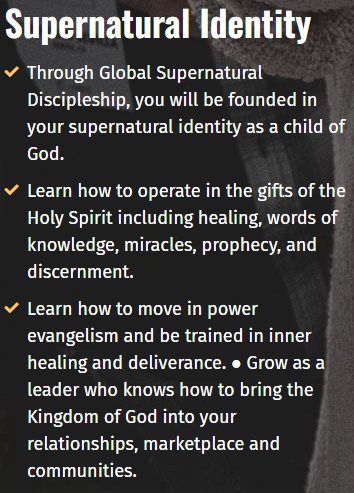
A different institution, Global Celebration School of Supernatural Ministry, also starts with identity:
Understanding who you are in Christ—and who Christ is in you—is one of the most important revelations in the Christian life. At GCSSM Online, we’ll help you grasp this truth deeply and unlock your heart to dream with God through the lens of your new identity.
The Encounter School of Ministry, founded by Catholics, with “many Global Awakening and Bethel influences,” focuses the first quarter of its curriculum on “identity and transformation.” ESM tells its students to move from a “performance mindset” to an identity-based mindset.
Performance vs. Identity
What is a “performance mindset?” The phrase did not originate with Christian teachers. A person with a performance mindset focuses on goals and the actions needed to achieve them. A performance mindset can be detrimental if someone believes that their worth depends totally on success or how they are viewed by others. In the NAR world, Christians are told to let go of a performance mindset in favor of an awareness of identity. If you have a performance mindset, you hesitate to believe that you can work miracles. Once you understand your identity as a child of God, you think differently.
Your identity as a child of God is a non-negotiable. You’re powerful, glorious, and outright awesome. - Kris Vallotton, Bethel School of Supernatural Ministry
This awareness will enable any Christian to work the same miracles Jesus did. Referencing John 14:12 in a video called “Your Identity as Sons of God,” Kris Vallotton teaches,
The reason why you do miracles is because your Daddy is God… Only God can heal the sick. You are acting like God, because you’re children of God. Listen, if you teach people to heal the sick, raise the dead, and cast out demons, and you don’t teach them who they are, then they have a performance-based identity. But as soon as you figure out who you are, you’re like, ‘if that’s who I am, where’s my power?
The Encounter School of Ministry presents the same teaching about how believers can fulfill John 14:12, once they abandon a performance-based identity and understand what it means to be a child of God. They teach that this is part of having a “renewed mind:”
The first quarter of the Encounter School of Ministry curriculum focuses on “Identity and transformation…Building a foundation for all ministry on your royal identity as sons and daughters of God who experience transformation by the renewal of the mind. … The first quarter focuses on the royal identity we receive as sons and daughters of God who have received an inheritance to do the works of Jesus and even greater works (Jn 14:12). Throughout the quarter students work to shift from a performance based mentality where their value and identity comes from what they do for God and into an identity where their value comes from who they are as sons and daughters of God alone.
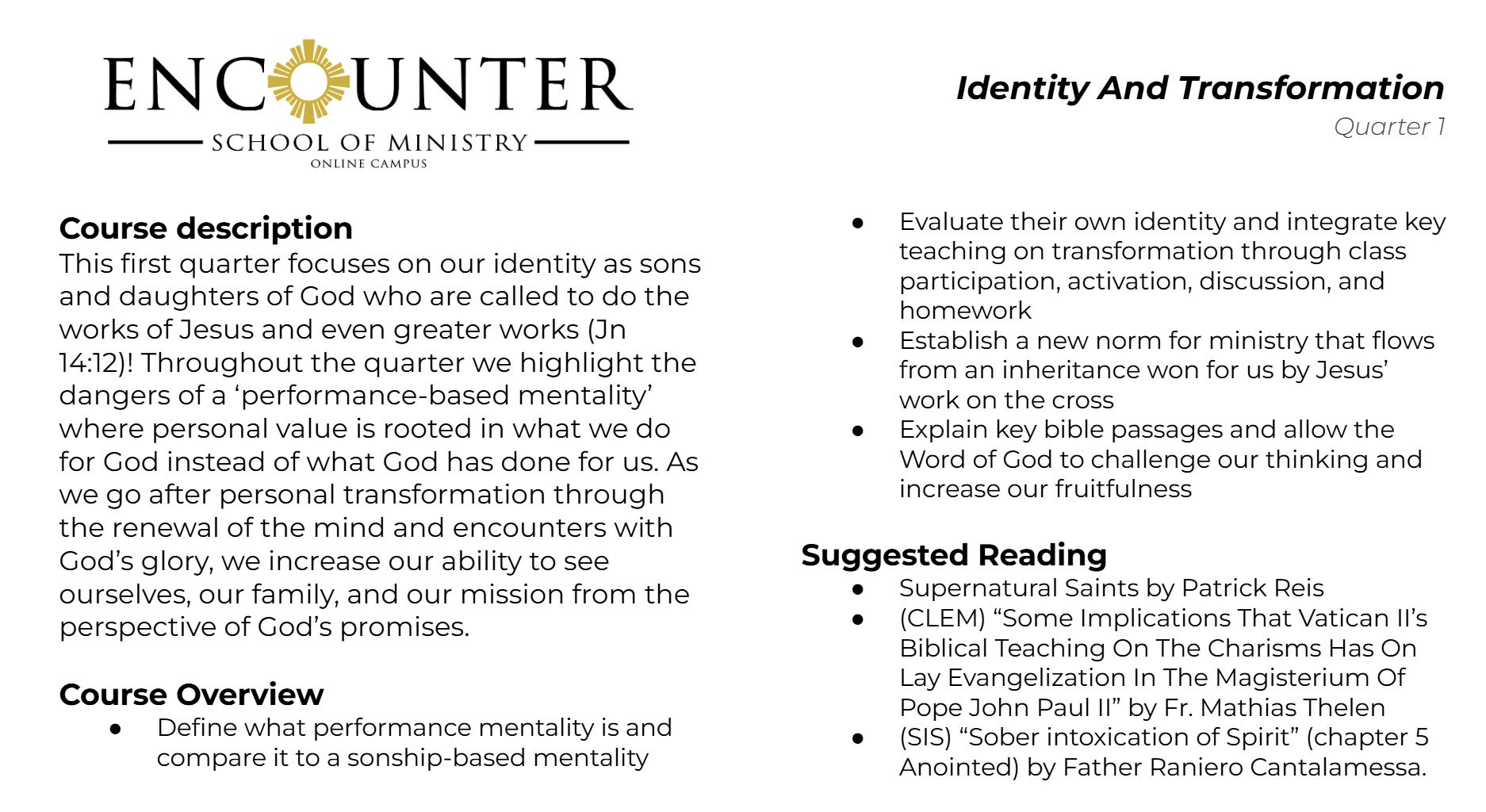
The shift from a performance mentality to an identity-based mindset is also mentioned in “Ten Truths I learned from Encounter Ministries” published on the webpage of the National Catholic Register:
We receive God’s inheritance; we don’t achieve it. So as Catholics we are all about receiving our inheritance as God’s children where our identity is based on who we are, not on what we have or what we do. This allows us to surrender a performance-based mentality as a condition where we try to earn our identity as God’s beloved children. We don’t have to worry about earning our identity, because Jesus died for us to have complete access to the Father. “He died for what we deserve so that we can receive what he deserved.”
Encounter Ministries offers a two-day “School of Identity” presenting some of the ideas from the first quarter of the Encounter School of Ministry.
Prince or Pauper?
Christians who teach this concept of identity often contrast it with a “pauper mentality” or “poverty mindset.”

Vallotton writes,
Paupers are plagued by a poverty mentality! They always feel like their resources are limited. They believe that when someone else receives something, it takes away some of the provision that could be theirs. They surmise that someone else’s blessing costs them. This is because they have not yet learned in the depths of their hearts that they are a child of the King, who can and will provide for every need they have.
The Encounter School of Ministry uses the story of Gideon from the Book of Judges to teach a similar lesson. “You cannot accomplish the amazing works that God has prepared for you unless you believe in who God says you are.” When an angel tells Gideon that he is a mighty warrior, Gideon does not believe the angel because he does not believe in himself. “...how can I save Israel? My family is the poorest in Manasseh, and I am the most insignificant in my father’s house.” Once Gideon learns his true identity, he acts with authority and courage. So, we should avoid false humility. “We don’t need to think little of ourselves in order for God to be glorified! Confidence in yourself is acknowledging what God has done in you. …Want to bring heaven to earth? Believe in yourself. Believe in God’s power and call at work in you and for you.” This is simply a re-statement of the teaching of the Bethel School of Supernatural Ministry:
Before Gideon tasted the fruit of victory, God called him a valiant warrior! Gideon’s initial response, however, was that of unbelief. As Steve Backlund says, “The future of a nation was trapped in the arguments of Gideon’s mind.” Before Gideon could step into his destiny, he had to believe in his true identity. This eventually led to the mighty deliverance of the Israelites from what seemed to be an impossible situation. Let’s declare: “I am a powerful world changer! The Lord is with me, if He is for me, what can be against me?”
Identity and the Miracles of Christ
At the 2016 Encounter Conference held at St. John Neumann parish in Sunbury, Ohio, Dr. Mary Healy presented on “Empowered Identity.” She explained that the temptation of Christ in the desert and his baptism show us how to move away from a false identity. The devil tried to make Jesus doubt his identity: “If you are the son of God…” He tempted Jesus to “be the Messiah of success and popularity;” he also tempts us to base our identity on seeking human esteem instead of having the praise of God. Jesus’ true identity is confirmed at his baptism: You are my son. Now that his identity is known, Jesus can work miracles:
From his baptism, and being filled with the holy spirit…he begins to minister in power. Not before. He is God, but he chose to live as man, dependent on the Holy Spirit. …
By working miracles, Jesus “will visibly demonstrate the kingdom.” Believers who understand their identity as God’s sons and daughters will be able to do likewise,
Notice what he’s saying here is attributing everything he does in his public ministry, not to his divine nature, but to his human nature, filled with the Holy Spirit. …Brothers and sisters, do you know why that’s significant? Because we get the same Spirit. That means it belongs to the very essence of being Christian that we would be little anointed ones, little Christs, filled with the same Spirit that filled him so that we could carry out a mission in the power of the Holy Spirit that’s modeled on his, that looks like his, that’s not only proclaiming the kingdom of God by words, but bringing it about with deeds of power by the power of his Holy Spirit.
I have discussed the serious theological problems with this teaching in a previous post. Here I focus on Healy’s teaching on identity: believers will not be able to see signs and wonders until they give up a false identity. Then they will be able to minister in authority and power just as Jesus did:
It’s precisely because we’re insecure in our true identity basing our identity on all kinds of human standards, that we lack the expectant faith that we need to see the Lord work through us in power… We are looking for ways that we can have our egos stroked by other people…we’re trying to shore up our identity…
All of these teachings about identity, whether from Protestants or Catholics, boil down to this claim: because God is your Father, you can do the same works that Jesus did. If you want to know your identity, just look at Christ. When the New Testament says “For those whom he foreknew he also predestined to be conformed to the image of his Son, in order that he might be the first-born among many brethren” (Rom 8,28-29), it was saying that “Jesus is the model of the normal Christian life” and we should do the works he did, and greater ones.2 Ironically, a teaching that promised to help you abandon a performance-based identity defined by doing things, ends up telling you that knowledge of your true identity empowers you to, well, do things.
Temple Identity
According to the Encounter School of Ministry, another way to consider identity is to understand that all the baptized are “temples:”
In each class students come to understand and experience their identity as temples of the Holy Spirit, be convicted of the new nature we have received from Jesus through baptism, live in the power of the Holy Spirit and respond to the authority we have received to expand the kingdom of God for a life of mission.
ESM, citing 1 Cor 3:16, instructs its students to make this declaration: “I am a Temple of the Holy Spirit and God’s Spirit dwells in me!” Is that a problem? Yes, a big one. The declaration fundamentally distorts what St. Paul was saying, and why. Let’s look at the text in English and Greek:
Do you not know that you are God’s temple and that God’s Spirit dwells in you? (RSV).
Οὐκ οἴδατε ὅτι ναὸς Θεοῦ ἐστε καὶ τὸ Πνεῦμα τοῦ Θεοῦ ἐν ὑμῖν οἰκεῖ;
Ouk oidate hoti naos theou este kai to pneuma tou theou en hymin oikei?
Don’t worry; I am not going to give a lesson in New Testament Greek! But you do need to know that Greek has two words for “you.” One is singular, and one is plural. In this passage, Paul uses the plural pronoun. He is not encouraging his flock to make a “declaration” beginning with the word “I” —that’s the last thing he wants! He wants to correct Corinthian Christians who make such declarations, saying things like, “I belong to Paul” and “I belong to Apollos” (see 1 Cor 3:4). To counter this, he employs the metaphor of a building (see 1 Cor 3:10) as a way to name the whole Church. In effect, he is saying, “You — all of you together — are one building, which is God’s temple, God’s field. Apollos and I are working together on the same project.” In 1 Cor 6:19-20 he again speaks of a temple using the plural form of “you.” “Do you (plural) not know that your (plural) body is a temple of the Holy Spirit within you (plural), which you (plural) have from God? You (plural) are not your own; you (plural) were bought with a price. So glorify God in your (plural) body.” There is only one temple, because all Christians form one body in Christ.
Having said that, there is an appropriate way that we can refer to an individual Christian as a temple. The ritual of baptism calls the body of a baptized Christian a temple of God's glory where the Holy Spirit dwells. For this reason a Christian’s body can be called a “temple of the Holy Spirit.” This is why, in our funeral customs, Catholic Christians respect the bodies of the dead and their places of rest. Nevertheless, in the New Testament, Christians are never called “temples,” in the plural, of the Holy Spirit. The Church is called the temple of the Holy Spirit, the house of God, God’s field. The New Testament itself refutes ESM’s teaching on “temple identity.”
ESM attempts to reinforce their teaching about “temple identity” with a partial quotation from St. Ambrose of Milan (d. 397): “…He who dwells in the temple has divine power…for it is a temple of Power.” This might make you believe that, since you are a temple in which God’s Spirit dwells, you have the power to “advance the Kingdom of God in and through our spheres of influence,” as ESM puts it. Is that what Ambrose is saying? Let’s look at his entire statement:
Therefore, He Who dwells in the temple has divine power, for as of the Father and of the Son, so are we also the temple of the Holy Spirit; not many temples, but one temple, for it is the temple of one Power. On the Holy Spirit, 3.12.91
In this passage, Ambrose wants to prove that the Holy Spirit is fully divine, that he is worshiped as God just as the Father and Son are worshiped, and that he has unity of nature with the Father and the Son. So he cites 1 Cor 3:16, which portrays the community of believers as a temple of the Holy Spirit. Ambrose stresses the unity of the temple: “not many temples, but one temple.” This means that, instead of declaring, “I am the temple of the Holy Spirit,” Ambrose declares “We are the temple of the Holy Spirit.” Thus, the full quotation actually contradicts ESM’s teaching on “temple identity.”
Pope Leo XIV recently cited Ambrose’s great disciple St. Augustine in making a similar point about how all Christians form a single temple:
The desire to work together for a common purpose reflects an essential reality: no one is Christian alone! We are part of a people, a body established by the Lord. When speaking of Jesus’ first disciples, Saint Augustine once said, “They became God’s temple, not only as individuals; together they were built into the temple of God” (En. in Ps. 131, 5).3
Drawing on Augustine and Ambrose, we could amplify the Pope’s statement: No one is Christian alone; no one is God’s temple alone.
Conclusion
Even if some Christians present erroneous teachings on “identity,” this should not discourage us from pondering our true identity in Christ. It is true that our Christian identity is not based on our own “performance,” but on the salvation won by Christ. If baptized, you are a son or daughter of God, but your sonship is derived from the unique sonship of Jesus Christ, the only-begotten and eternal Son. Your identity is derived from his, but not identical. The Catechism of the Catholic Church teaches that we can’t even imagine what the relationship of the Son to the Father is like:
2780 We can invoke God as "Father" because he is revealed to us by his Son become man and because his Spirit makes him known to us. The personal relation of the Son to the Father is something that man cannot conceive of nor the angelic powers even dimly see: and yet, the Spirit of the Son grants a participation in that very relation to us who believe that Jesus is the Christ and that we are born of God.
You can know your identity as a child of God, and call God “Father,” only because of the gift of God’s only Son:
But when the time had fully come, God sent forth his Son, born of woman, born under the law, to redeem those who were under the law, so that we might receive adoption as sons. And because you are sons, God has sent the Spirit of his Son into our hearts, crying, “Abba! Father!” So through God you are no longer a slave but a son, and if a son then an heir. — Gal 4:4-7, RSV
Identity matters. Every Christian must discern his or her vocation, and that is impossible without a healthy knowledge of one's self. Regarding the Christian quest for self-knowledge, I have often found writers on spirituality reporting that St. Francis of Assisi would repeat the prayer, “Who are you, O Lord, and who am I?” These writers rarely give the complete prayer, or the full story. Both are instructive.
According to The Little Flowers of St. Francis, Brother Leo came upon St. Francis praying alone at night:
[Brother Leo] beheld him kneeling in prayer with his face and hands lifted up towards heaven, and crying, in fervor of spirit: “Who art thou, my dearest Lord? and who am I, a most vile worm and thy most unprofitable servant?” and these words he repeated over and over again, adding nothing more.
Francis explained to Leo,
Know, dearest brother, that when I said those words which thou didst hear, two great lights were before my soul, the one the knowledge of myself, the other the knowledge of the Creator. When I said: ‘Who art thou, my dearest Lord?’ I was in a light of contemplation, in which I beheld the abyss of the infinite goodness and wisdom and power of God; and when I said: ‘Who am I?’ I was in light of contemplation wherein I saw the lamentable abyss of my own vileness and misery…
Francis then related how the Lord had asked him for three gifts. He wondered what he could give the Lord, since he had no money or possessions. Then he understood. Precisely because he owned nothing, the only three gifts he could offer the Lord were poverty, chastity, and obedience.
Faithful Reader, if that is a “poverty mentality,” we could sure use more of it in the Church.
Global Supernatural Discipleship online consists of two, 5-month courses. Tuition is $999 per course.
Patrick Reis, Supernatural Saints. A School of Ministry from the Saints. Brighton: Encounter Ministries, 2022,18.
For those who are wondering about the original Latin, it runs: Certe facti sunt templum Dei; non tantum templum Dei singuli, sed et omnes templum Dei simul.
Agreed. In the NAR, "identity" = believing in yourself to accomplish your will as opposed to believing in God's power to accomplish His will. It is very much a religion of SELF and self-glory rather than all things for God's glory. They shamelessly twist the account of Jesus' baptism to insinuate that Jesus did not know His true identity until God announced, "this is my Son" and then they use that strawman argument to further claim that He was unable to perform miracles until He knew His true identity. However, that just goes back to their teaching that Jesus was not divine but a kenotic Jesus who worked miracles as a mere man in right relationship with God. Thus, they deny the doctrine of the Trinity just as assuredly as the Jehovah's Witness/Watchtower cult does. It's a tangled web they weave when at first they intended to deceive, but this rejection of Christ's true identity has the antichrist spirit written all over it.