
Different Kinds of Baptism?

Note: a version of this post appeared in The Catholic Times, the newspaper of the Diocese of Columbus, on January 6, 2026.
St. Paul reminded the Ephesians that there is “one Lord, one faith, one baptism” (Eph 4:5), calling them to unity. Today, Christians do not appear completely united on this point, since some distinguish between “water baptism” and “Spirit baptism.”
The distinction goes back to the teaching of the Anglican clergyman John Wesley (1703-1791), who became the founder of Methodism. Wesley taught that baptism was a sacrament, an outward sign of an inward grace, instituted by Christ, including a washing with water as “a sign and seal of regeneration by his Spirit.” At the same time, Wesley affirmed that an adult could receive baptism without being truly born again, and that infant baptism did not complete one’s rebirth:
A man may possibly be ‘born of water’ and yet not be “born of the Spirit.” There may sometimes be the outward sign, where there is not the inward grace.
Spirit baptism, he taught, led to “entire sanctification” that empowered the Christian to witness, serve, and live a holy life. Baptism was called the “first grace” and entire sanctification was called the “second grace.”
The rise of Pentecostalism in North America led to a further development and changing of these ideas.
Charles Fox Parham (1873-1929), originally a lay preacher in the Methodist Church, began a new movement called Holiness Pentecostalism in Kansas. Parting company with Methodism, Parham taught that there was a “third work of grace” called “baptism in the Holy Ghost” that empowered the Christian for service. He determined that speaking in tongues was evidence that one had received that gift and taught this as early as 1891.
While Wesley had emphasized holiness, Parham shifted the focus to the ability to serve in power, including healing the sick. One of his students, William Seymour (1870-1922), helped spread the teaching about speaking in tongues as evidence of baptism in the Holy Spirit at a church he led in Los Angeles; there the famous Azusa Street Revival began in 1906.
When the charismatic movement moved into mainstream Protestant denominations and the Catholic Church in the 1960s, the Pentecostal teaching on “baptism in the Holy Spirit” came with it.
Today, we see some Catholics uncritically embracing Pentecostal doctrines to such a degree that they have accepted and are teaching a distinction between different kinds of baptism, a distinction that is not part of authentic Catholic understanding. For example, Encounter Ministries distinguishes “water baptism” and “spirit baptism.” Like Parham, they emphasize power over holiness, teaching that the effects of baptism in the Holy Spirit include “empowerment to do the works of Jesus” and “supernatural ministry.”
Authentic Catholic doctrine, as well as the way it is expressed in sacramental celebrations, does not recognize a distinction between “water baptism” and “Spirit baptism.” In the Catholic ritual for the baptism of infants, the priest or deacon mentions baptism “by water and the Holy Spirit” five times, referencing the words of Jesus to Nicodemus: “Amen, amen, I say to you, no one can enter the kingdom of God without being born of water and Spirit (John 3:5).”
The teaching of recent popes also affirms the unity of “water baptism” and “spirit baptism.”
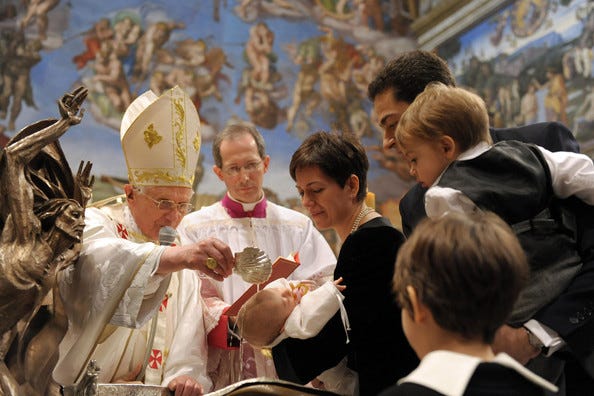
In 1998, Pope St. John Paul II taught that the descent of the Holy Spirit on Jesus at his baptism in the Jordan River “prefigured the gift of the Holy Spirit, which would be imparted to Christians in baptism.” Ten years later, Pope Benedict XVI, speaking on the feast of the Baptism of the Lord, said, “Christ’s entire mission is summed up in this: to baptize us in the Holy Spirit, to free us from the slavery of death and ‘to open heaven to us’…” When Pope Benedict said this, was he speaking of a “baptism in the Holy Spirit” distinct from “water baptism?” No. We know this because he went on to say: “This is what happened for the 13 children to whom I administered the Sacrament of Baptism this morning in the Sistine Chapel.” In other words, whenever someone receives the Sacrament of Baptism, he or she is baptized in the Holy Spirit. The Sacrament of Confirmation confirms and strengthens baptismal grace, reinvigorating the gifts of the Holy Spirit in the soul of the baptized.
Of course, those baptized as infants must choose to live out their baptism. Some never have the chance, because their parents and godparents do not follow through with their commitment and fail to give them a sound Catholic upbringing. Others, whether baptized as infants or as adults, fall away from the life of grace through indifference, or spiritual laziness, or by surrendering to serious sin. While we must recognize and respond to these obvious facts, we can do that without distorting or discarding the authentic Catholic doctrine of the sacraments.
Speaking to the recently baptized in July 2025, Pope Leo XIV offered advice that all the baptized should heed:
Baptism introduces us into communion with Christ and gives us life. It commits us to renounce a culture of death that is very present in our society. This culture of death manifests itself today in indifference, contempt for others, drugs, the search for an easy life, sexuality that becomes entertainment and the objectification of the human person, injustice, etc.
Baptism makes us witnesses of Christ. In the rite of Baptism … we receive a candle lit from the Paschal candle. It is the light of Christ who died and rose again that we commit ourselves to keeping lit by nourishing it through listening to the Word of God and assiduous communion with Jesus in the Eucharist.
Great article and very helpful. It's such a problem to talk of Baptism in the Spirit as though we don't receive the fullness in Baptism and Confirmation. Yes there can be a personal conversion that brings our Baptismal graces to the fore. But we need to be careful in the language we use.
FYI, generational sin is getting more publicity: https://tanbooks.com/products/books/sins-of-the-father-a-catholic-and-biblical-approach-to-generational-curses/